Auroras and space weather, now
Reading…
- Estimated Kp, real time
- —
- X-rays
- —
- Solar wind
- —
- Bz field
- —
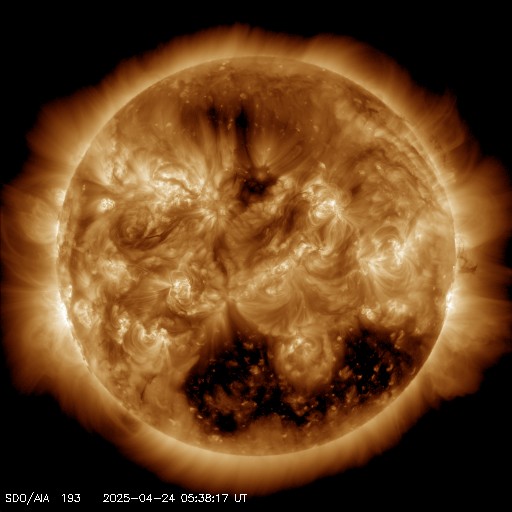
Live Kp index, northern lights forecast for your location, solar flares and wind, image of the Sun: data from NOAA (SWPC) and NASA (SDO).
Geomagnetic activity over 10 days
ObservedEstimatedForecastStorm (Kp 5 and above)
The Kp index measures how disturbed Earth’s magnetic field is, from 0 (quiet) to 9 (extreme storm). From 5 up it is a geomagnetic storm: auroras move down toward mid-latitudes.
Auroral oval, 30-minute forecast
The denser the green, the more likely an aurora is overhead. It can also be seen low on the horizon up to a few hundred kilometres away.
An aurora from ?
—
Solar X-rays, 24 hours
Each class is ten times stronger than the previous one. M and X flares can black out shortwave radio on Earth’s day side.
Flares, last 7 days
NOAA scales, today and the next 3 days
About this page
What is the Kp index?
It measures how disturbed the Earth's magnetic field is, from 0 (quiet) to 9 (extreme storm). From 5 upwards it is a geomagnetic storm: auroras move down towards mid-latitudes.
When can auroras be seen from France?
During a strong storm: by the NOAA rule used here, it takes Kp 8 from Paris, Lille or Brest, and Kp 9 from Strasbourg. Further south, only an exceptional storm, like the one in May 2024, makes it possible. The page works out the Kp needed from your location; you also need a dark, clear night: see tonight's sky.
The sources
Kp index, aurora oval (OVATION model), X-rays, solar wind and scales: NOAA Space Weather Prediction Center. Image of the Sun: NASA Solar Dynamics Observatory. Geomagnetic latitude calculated on your device.